
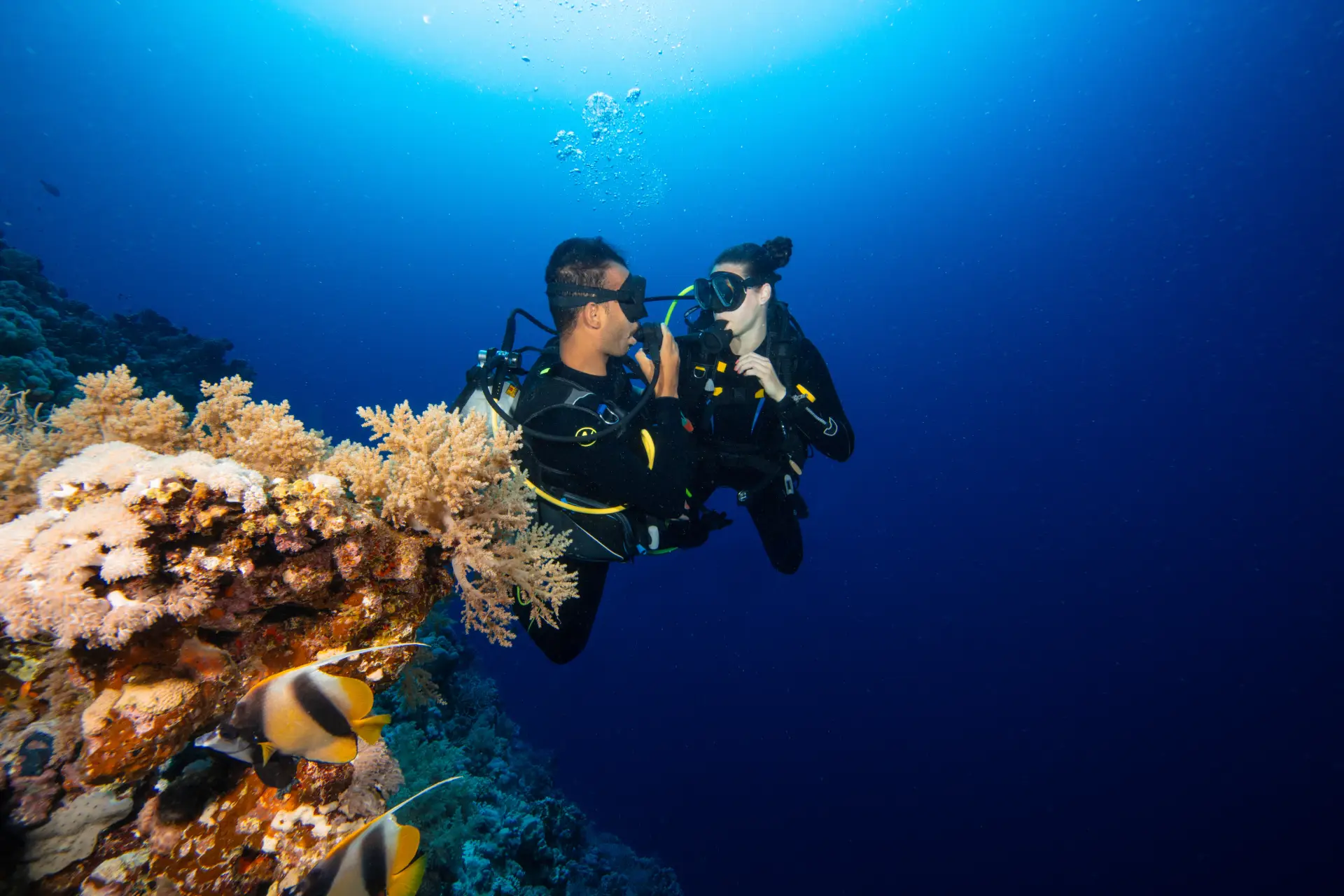
You’re 18 meters down on a wall, and your buddy is waving a flat hand at you. Is that a hello? A problem? Are they just cold? Underwater, you can’t ask. That’s the whole reason hand signals exist.
There are dozens of them floating around, but you don’t need dozens. These twelve cover nearly everything that comes up on a typical dive, and they’re the ones every guide in Bohol expects you to know before you get in the water.
Why Signals Matter More Than You Think
Water carries sound, but you can’t shout through a regulator. Even if you could, a tank bang or a yell isn’t going to say “turtle, left side” with any accuracy. A clear signal does.
Good signals also keep things calm. A diver who can say “I’m low on air” in half a second is a diver who’s still in control. One who can’t tends to panic, and that’s when small problems get bigger.
The Essential Twelve
1. OK
Touch your thumb and index finger into a circle and hold the other three fingers up. This is a question and an answer. Someone gives it to you, and you give it right back. Use it often, especially at the start of a descent and after anything unexpected.
2. Something’s Wrong
Hold a flat hand out and rock it side to side. It doesn’t say what the problem is. It says there is one. Point to the thing that’s bothering you (your ear, your mask, your gear) and your buddy will take it from there.
3. Up
Thumb up. Surprisingly, this does not mean “good job.” It means “let’s ascend.” Don’t give it casually, or you might end your dive early.
4. Down
Thumb down. It’s the same idea in the other direction. You’ll use this at the start of every dive, usually while hovering at the surface with your BCD deflating.
5. Stop
Flat hand, palm out, like a traffic officer. Your guide might use this when they spot something you shouldn’t swim over, or when there’s a change of plan. Freeze and look at them.
6. Slow Down
Flat hand, palm down, pressing gently toward the bottom a few times. Newer divers kick hard when they’re excited. A slower pace saves air and lets you see more.
7. Look
Point two fingers at your eyes, then point at what you want your buddy to see. This is the fun one. It’s what a guide does when there’s a frogfish on a sponge, a sea snake in the sand, or a turtle cruising along the wall. Many guides will add their own little signals for animals, like a flapping hand for a turtle, so ask at the briefing. Our guide to Bohol’s marine life will give you a sense of what you might be pointed toward.
8. Low on Air
Make a fist and hold it against your chest. It means you’re getting low, not that you’re in trouble. Give it early, and give it clearly. Ending a dive on time is always better than ending it in a hurry.
9. Out of Air
Slide a flat hand across your throat in a cutting motion. This one means business. It tells your buddy you need air now, and you need it from them.
10. Share Air
Point at your regulator or touch your mouth, then point to your buddy’s alternate air source. You’ll practice this in your Open Water course, and it’s worth practicing again before any trip. The best time to know your buddy’s gear setup is before you need it.
11. Safety Stop
Hold one flat hand over three raised fingers on the other hand. Three fingers, three minutes, at about five meters. You’ll see this near the end of nearly every dive, and it’s one of the easiest habits to keep.
12. Stay Together
Hold two index fingers side by side. It means “buddy up” or “stay close.” You’ll see it when visibility drops, when there’s a current, or when someone’s drifted a bit too far from the group.
Signals You’ll Probably Add Along the Way
Once these twelve feel natural, you’ll start picking up others. Ear problems (point at your ear), cold (hug yourself), a “which way?” shrug and a “this way” point all come up quickly. Check pressure is another handy one. Hold up a fist to ask, or show your gauge reading with your fingers to answer.
The big caveat is that signals can vary slightly between instructors, regions and training agencies. It’s one reason every good dive briefing includes a quick review. Don’t skip it, and don’t be shy about asking, “How do you signal X?”
Tips for Using Them Well
Make them big and slow. A rushed, tiny gesture is easy to miss, especially with a mask and in a bit of current.
Get your buddy’s attention first. Tap a tank, wave a hand, or use a rattle if you’ve got one. Then signal.
Always answer. If someone gives you an OK, give one back. If you don’t understand, say so. A shrug and a head tilt work fine.
And practice on the surface before you go down. Two minutes on the boat saves a lot of confusion at depth.
Bohol Is a Great Place to Get Comfortable
The water around Panglao is warm and clear, and the dive sites suit all levels. That makes it an easy place to build good habits. Whether you’re getting ready for your first open water dive or brushing up before a deeper wall dive at Balicasag, you’ll get plenty of chances to use all twelve of these. If you’re curious about where you’ll be using them, take a look at the dive sites around Bohol.
Brand new to all this? A course is the best way to learn signals properly, with someone watching your hands and correcting you gently. You can see what’s on offer in the diving courses in Bohol.
Learn these twelve and you’ll never have to wonder what that waving hand means again.