
The Two-Banded Resident: Exploring the Clownfish of the Red Sea
If you ask any non-diver to name a fish, “Nemo” is almost always the first answer. Thanks to the magic of cinema, the clownfish (or anemonefish) has become the global ambassador for coral reefs. However, if you are diving in the Red Sea—whether you’re exploring the pristine walls of Ras Mohammed or the shore reefs of Hurghada—you won’t actually find the Amphiprion ocellaris (the famous Western Clownfish).
Instead, you get to meet a much more exclusive celebrity: the Two-Banded Anemonefish (Amphiprion bicinctus).
While the Indo-Pacific (places like Bohol and the Coral Triangle) is home to nearly 30 different species of anemonefish, the Red Sea is characterized by its high rate of endemism. The Two-Banded Anemonefish is the dominant species here, found almost nowhere else on Earth outside of the Red Sea and the Gulf of Aden.
Defining the Species: Amphiprion bicinctus
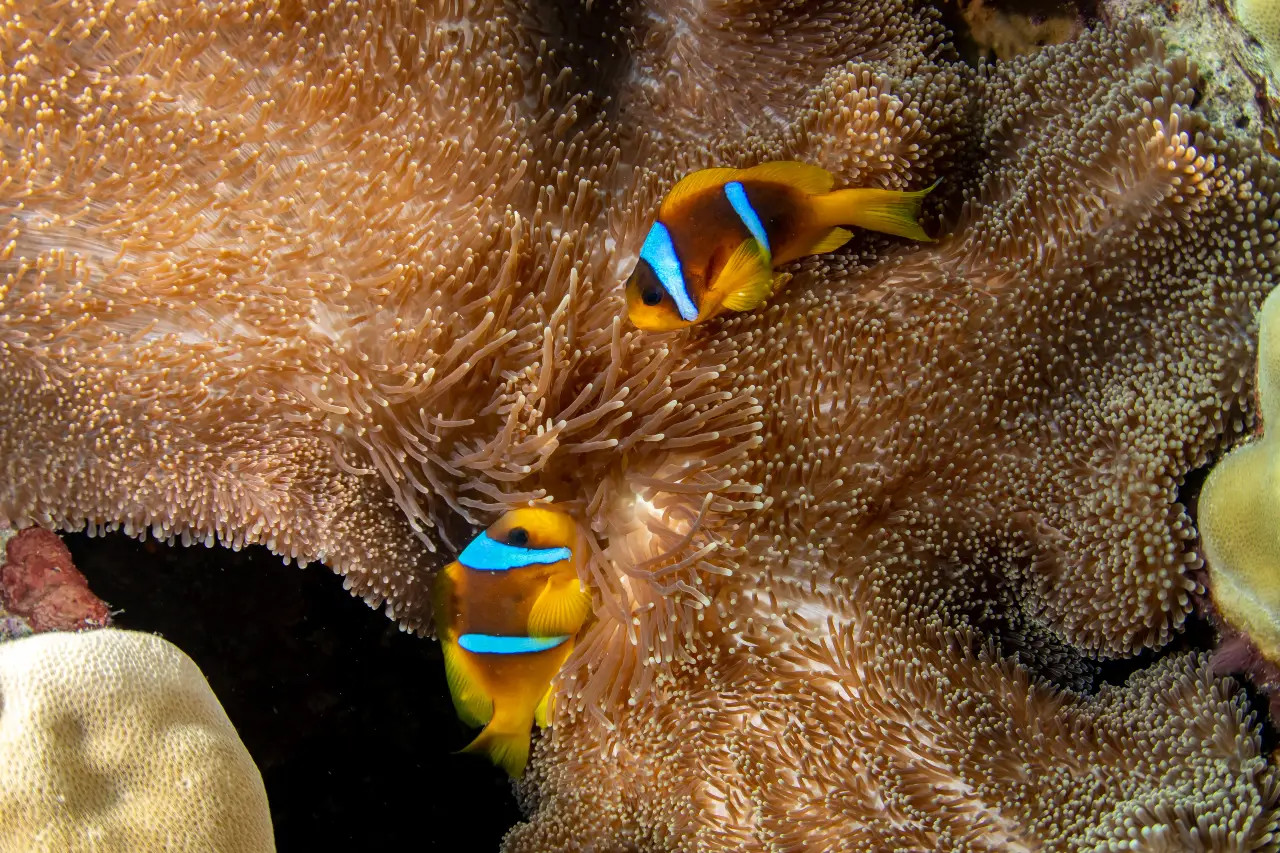
The Red Sea Clownfish is easily distinguished from its cousins. As the name suggests, its most defining feature is the two white, black-edged vertical bands that wrap around its body.
-
Coloration: Juveniles and young adults are typically a bright, vibrant yellow or orange. As they mature, especially the dominant females, their color can darken significantly, sometimes turning a deep, rich mahogany or near-black on their flanks.
-
The Bands: The first band is located just behind the eye, while the second runs through the middle of the body, starting at the dorsal fin and ending near the belly.
-
Size: They are relatively small but robust, with females (the larger of the pair) reaching up to 14 centimeters (about 5.5 inches) in length.
 The Science of Symbiosis: A Deadly Partnership
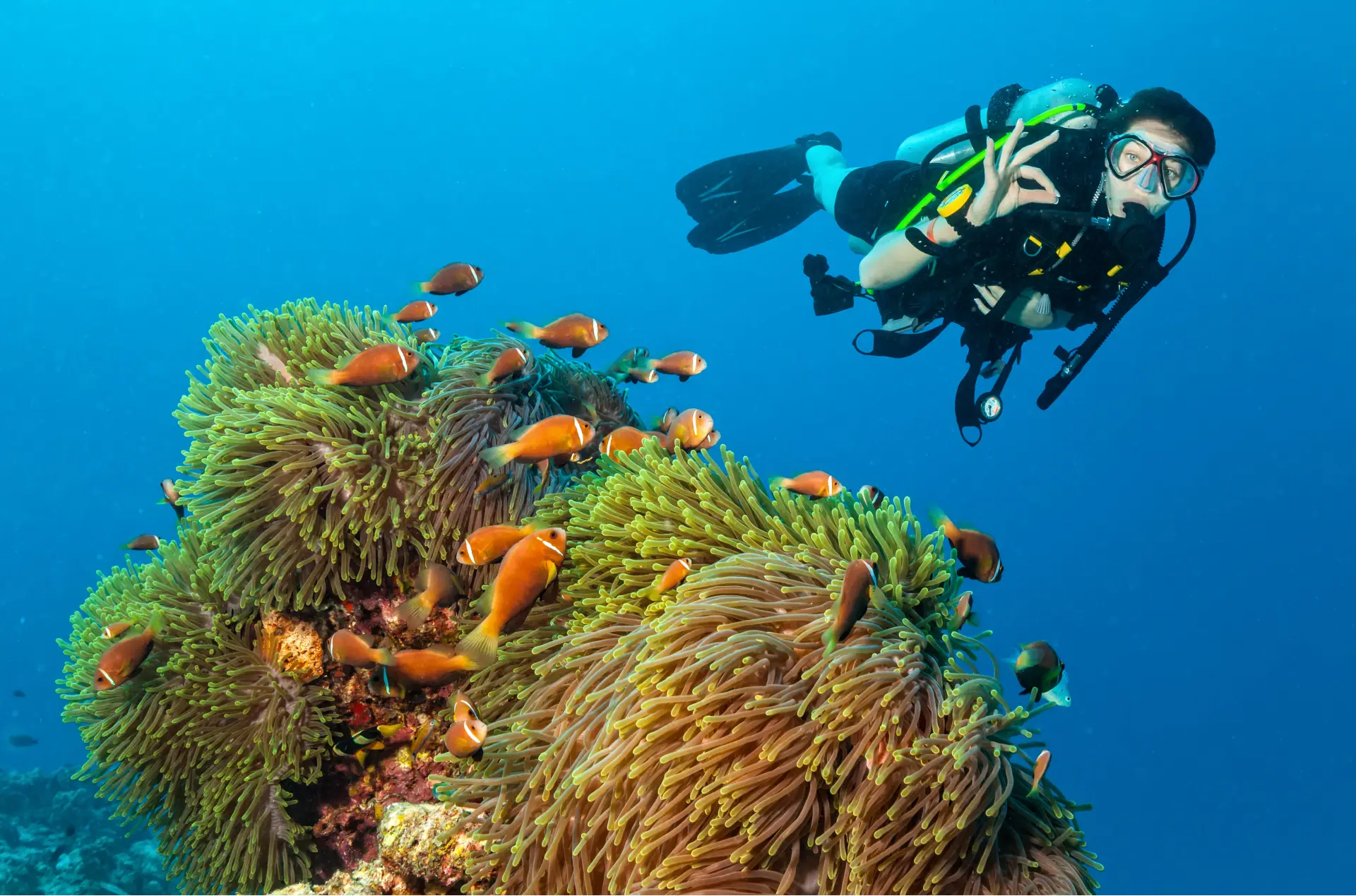
The most fascinating aspect of the Red Sea Clownfish isn’t just the fish itself, but its relationship with its host. In the Red Sea, Amphiprion bicinctus is known to associate with five different species of sea anemone, though the most common hosts are the Bubble-Tip Anemone (Entacmaea quadricolor) and the Magnificent Sea Anemone (Heteractis magnifica).
This is a “mutualistic” relationship—a biological win-win that has fascinated scientists for decades.
How They Survive the Stings
Sea anemones are predators. Their tentacles are armed with nematocysts—tiny, stinging harpoons that inject venom into unsuspecting fish. For almost any other creature, touching an anemone is a death sentence.
The clownfish, however, has evolved a specialized mucus coating on its skin. This mucus lacks the specific proteins that trigger the anemone’s stinging response. Essentially, the clownfish wears a “chemical cloak” that makes the anemone think it is touching itself or a piece of debris.
What’s in it for the Anemone?
The fish gets a safe, venomous fortress to hide from predators like groupers or snappers. But what does the anemone get?
-
Defense: Clownfish are surprisingly aggressive. They will fiercely defend their anemone from butterflyfish, which are notorious for eating anemone tentacles.
-
Nutrients: The waste produced by the clownfish (ammonia) provides vital nutrients for the anemone’s growth.
-
Aeration: The constant movement of the fish through the tentacles helps circulate oxygen-rich water through the anemone’s body.
 Gender Benders: The Complex Social Hierarchy
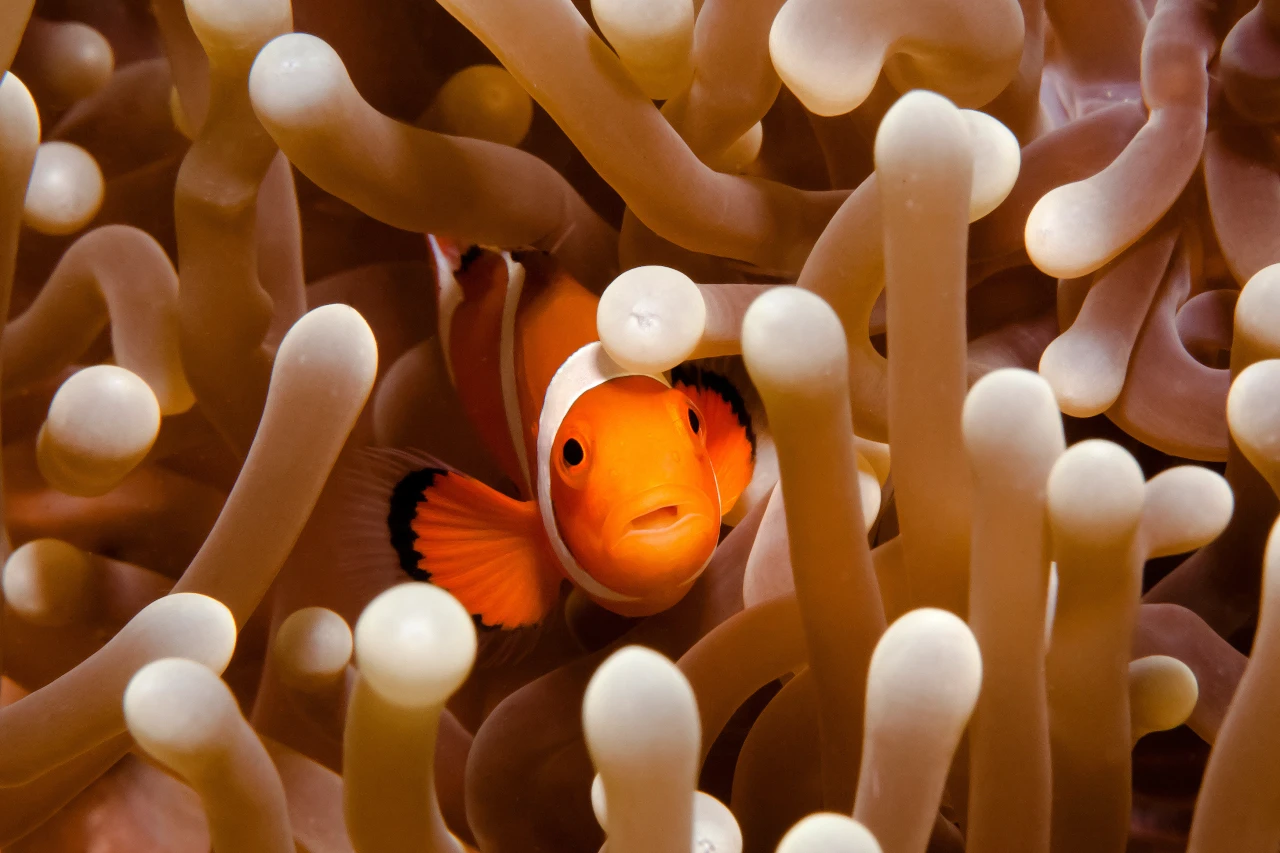
If you see a group of clownfish in an anemone, you are looking at a very strict social order. Red Sea Clownfish are protandrous hermaphrodites. This means they are all born male, but they possess the ability to change their sex.
Within a single anemone, there is typically one large dominant female. She is the “boss” of the reef. Below her is one breeding male, who is smaller and serves as her mate. Beneath them may be several smaller, non-breeding males who exist in a state of arrested development.
If the dominant female dies or is eaten, the breeding male undergoes a hormonal shift. Within days, he begins to grow larger and transforms into a female. The largest of the non-breeding males then steps up to become the new breeding male. This ensures that the “nest” is never without a reproductive pair.
Watching Them Grow: The Life Cycle
Next time you are diving in Hurghada or Sharm, look closely at the base of the anemone. If you see a patch of orange “fuzz” on the nearby rock, you’ve found a nest.
The male is responsible for cleaning a patch of rock where the female will lay hundreds (sometimes thousands) of eggs. Once laid, the male becomes the primary guardian. He fans the eggs with his fins to keep them oxygenated and nips away any debris or dead eggs. After about 6 to 10 days, the larvae hatch and drift into the plankton, eventually finding their own anemone to call home.
Photography Tips: Capturing the “Peek-a-Boo”
The Red Sea Clownfish is a favorite for underwater photographers, but they can be frustrating subjects. They are constantly in motion, darting in and out of tentacles.
-
Be Patient: Don’t chase them. If you stay still near the anemone, the fish will eventually get curious and “peak” out at you.
-
Focus on the Eye: Because they move so much, use a fast shutter speed (at least 1/250) and lock your focus on the eye.
-
Low Angle: Get level with the anemone rather than shooting top-down. This captures the “house” feel of the environment.
-
Watch for Aggression: If the clownfish starts swimming directly at your mask or camera port, it’s not being “friendly”—it’s trying to drive you away from its home. This “charging” behavior often makes for great head-on shots!
Where to See Them in the Red Sea
While they are found throughout the Red Sea, some sites offer spectacular “Anemone Cities.“
-
Ras Mohammed National Park (Anemone City): As the name suggests, this site is a literal metropolis of anemones and clownfish.
-
The Thistlegorm: Even on this historic wreck, you’ll find anemones clinging to the railings and masts, proving that life finds a way even on rusted steel.
-
Marsa Alam & Hurghada: Many of the house reefs and shallow lagoons are perfect for snorkelers and beginner divers to see these fish in just 3–5 meters of water.
The Red Sea Clownfish is a reminder that you don’t need to be the biggest or the most dangerous creature in the ocean to be the most successful. Through cooperation, a bit of specialized slime, and a lot of attitude, this tiny fish has conquered one of the most competitive marine environments on the planet.